

Goal Mountain
An AI goal companion that turns long-term ambitions into adaptive, actionable plans.
01 - Overview
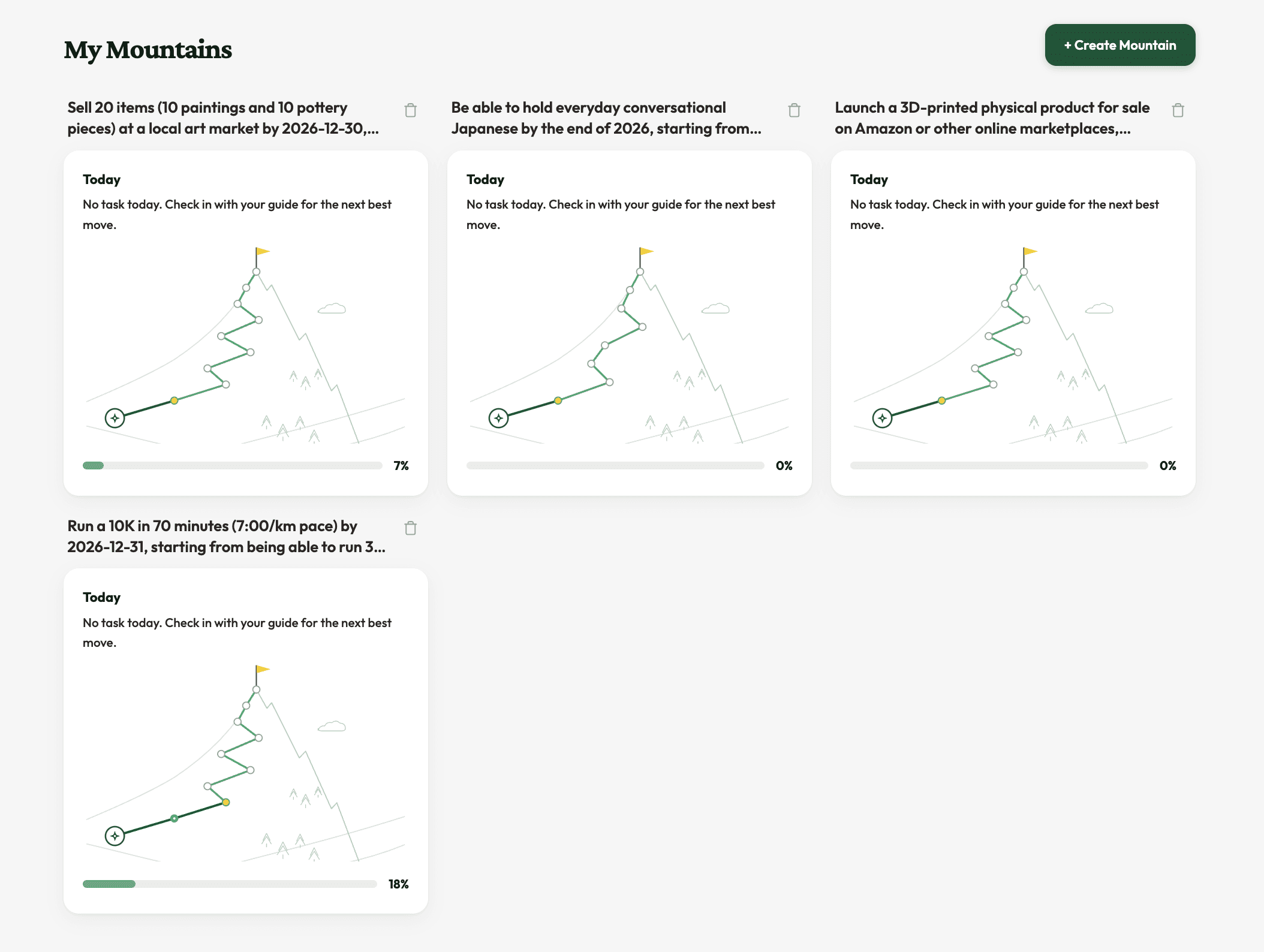
Goal Mountain is an AI-powered goal-achievement web app that transforms long-term ambitions into personalized mountain journeys. Each goal becomes a mountain, major stages become milestones, and a measurable outcome becomes the summit.
AI act as the guide, strategist, researcher, planner, companion to help the users turn their vague ambition into measurable outcome and structure route, making personalized weekly plan, and record the daily progress check-in. It has the long term behavior memory to do the automatic reflection and adjust the plans at any time.
- Your role:
- Product strategy, UX and UI design, AI interaction design, Agent and data architecture, Frontend implementation, Prompt design and evaluation planning
- Project type: self-initiated project
- Timeline
- June–July 2026
- Ongoing MVP
- Main tools:
- Figma, Next.js, TypeScript, Tailwind CSS, Supabase, OpenAI API, GitHub, Claude Code
- Current status:
- MVP complete, in self-testing; next step is user testing
02 - The Problem
There are three challenges I work on for Goal Mountain:
Long-Term Goals Lack a Clear, Prioritized Route
People may know what they want to achieve, but large goals are difficult to translate into clear, manageable, and prioritized steps. Without a clear route, it is hard to know where to start or what to focus on next.
Static Plans Cannot Keep Up With Real-Life Change
Long-term goals rarely go exactly as planned. When users fall behind, encounter new constraints, or progress differently than expected, fixed plans quickly become outdated.
Guidance Does Not Learn From the User Over Time
One-off guidance lacks an ongoing understanding of the user’s current state, past progress, recurring blockers, and what has or has not worked. Without learning from this history, future advice and plans cannot meaningfully adapt.
03 - Research & Product Opportunity
Secondary Research
Long-term goals become more actionable when progress is made proximal and concrete
Evidence / Finding
Research suggests that proximal subgoals can make distant outcomes feel more manageable by creating nearer indicators of progress and strengthening self-efficacy. Beyond setting a goal, implementation-intention research shows that specifying when, where, and how an action will occur helps bridge the gap between intention and behavior; a meta-analysis of 94 independent tests found a medium-to-large positive effect on goal attainment.
Product Implication
Goal Mountain should break a long-term goal into meaningful milestones, then translate the current priority into concrete, context-specific actions in the weekly plan.
Effective goal pursuit requires a feedback loop, not a fixed plan
Evidence / Finding
Research suggests that plans become less effective when they no longer reflect actual progress or changing conditions. Rather than treating every deviation as a reason for immediate replanning, self-regulation research supports evaluating performance and emerging barriers, then using that feedback to adjust subsequent actions and future plans when needed.
Product Implication
Goal Mountain should use progress tracking and reflection to create a feedback loop: surfacing meaningful patterns and blockers to the user while also using that evidence to adapt future weekly plans when needed.
Long-term guidance becomes more valuable when it learns across interactions
Evidence / Finding
Research suggests that persistent context allows AI guidance to build on prior interactions rather than treating each session as a new starting point. This can support more personalized responses over time while reducing the effort required for users to repeatedly re-establish relevant context. (Hao et al., 2026)
Product Implication
Goal Mountain should retain meaningful context across the user’s journey so future planning and guidance can build on what the system has already learned, without requiring users to repeatedly explain their goal and situation.
Supporting Insight — Timely support can reinforce accountability without becoming intrusive
Evidence / Finding
Research suggests that progress monitoring is more effective when outcomes are reported or made visible to others, supporting a role for perceived accountability. Proactive support is most useful when delivered at moments of need and receptivity rather than continuously, since excessive prompting can create intervention burden.
Product Implication
Goal Mountain should use lightweight, context-sensitive check-ins to reinforce accountability without becoming intrusive.
From research principles to product design
| Research principle | Product response |
|---|---|
| Make progress concrete | Mountain → Milestones → Summit |
| Adapt from feedback | Weekly Plan + Progress Tracking + Insights |
| Learn across interactions | Reflection + Long-Term Memory |
| Support accountability without intrusion | Contextual AI Guide check-ins |
Together, these principles defined the first product model I moved into prototyping.
04 - Translating Research into the First Product Concept
Based on these principles, I designed the first end-to-end experience around three layers: a Mountain that makes the long-term route visible, a Weekly Plan that translates the current milestone into action, and a feedback loop that uses progress, reflection, and memory to adapt future guidance.
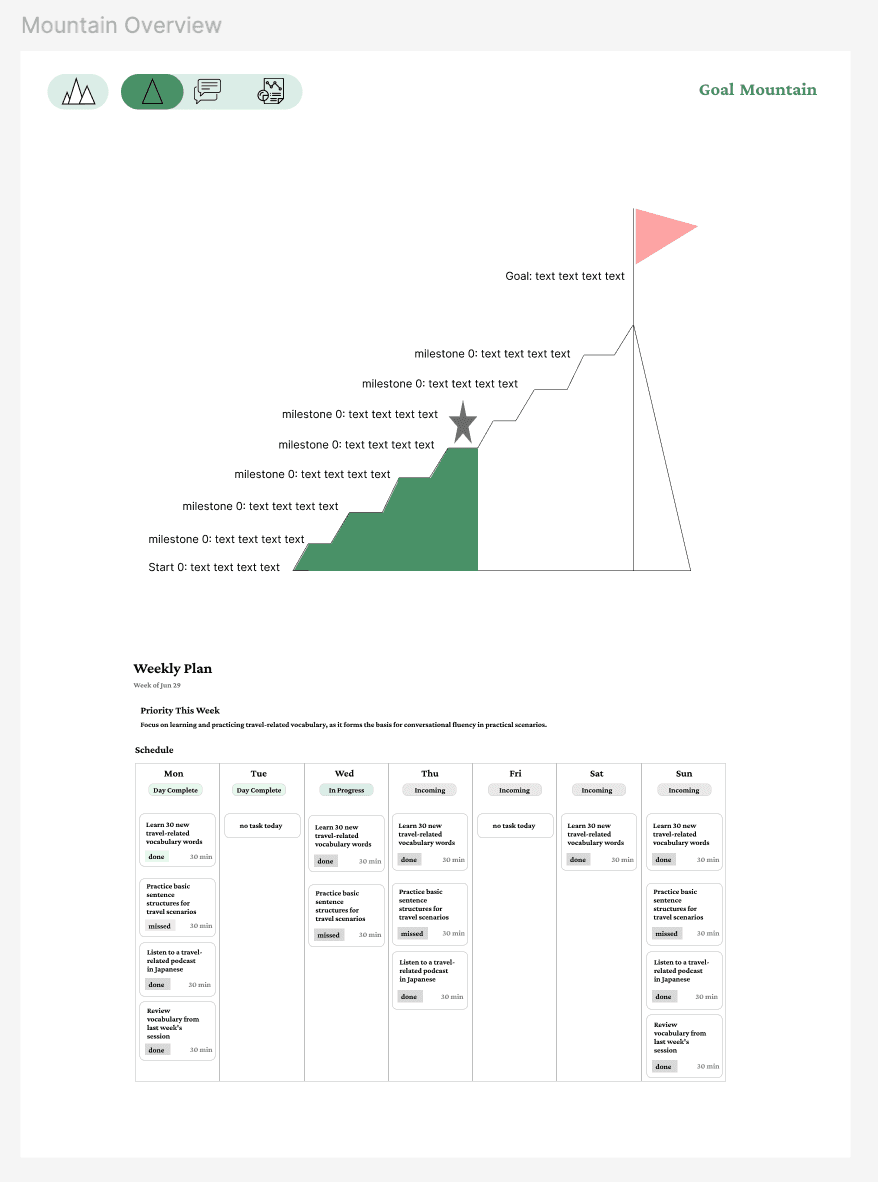
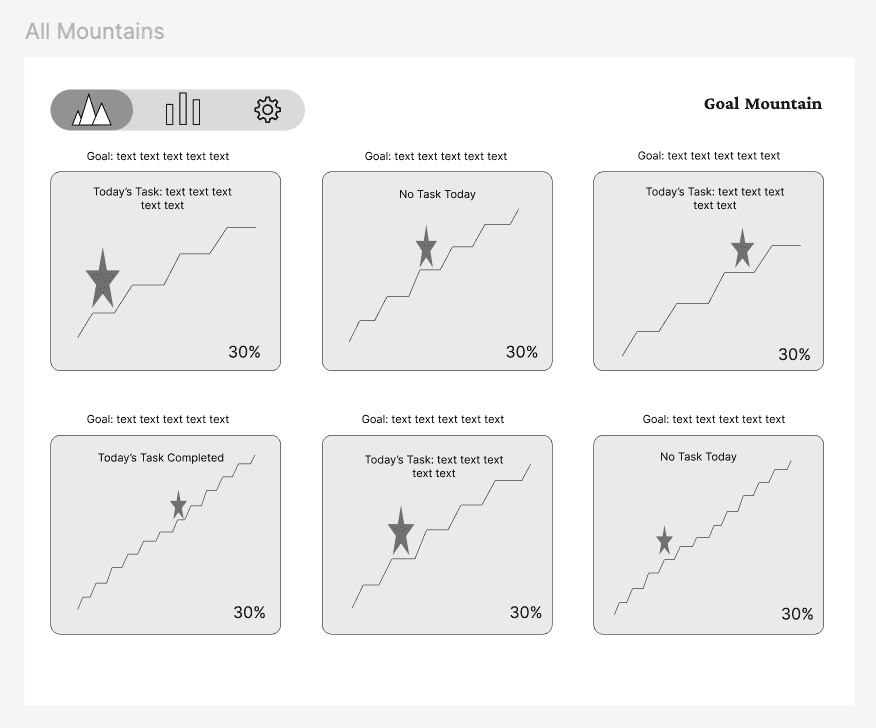
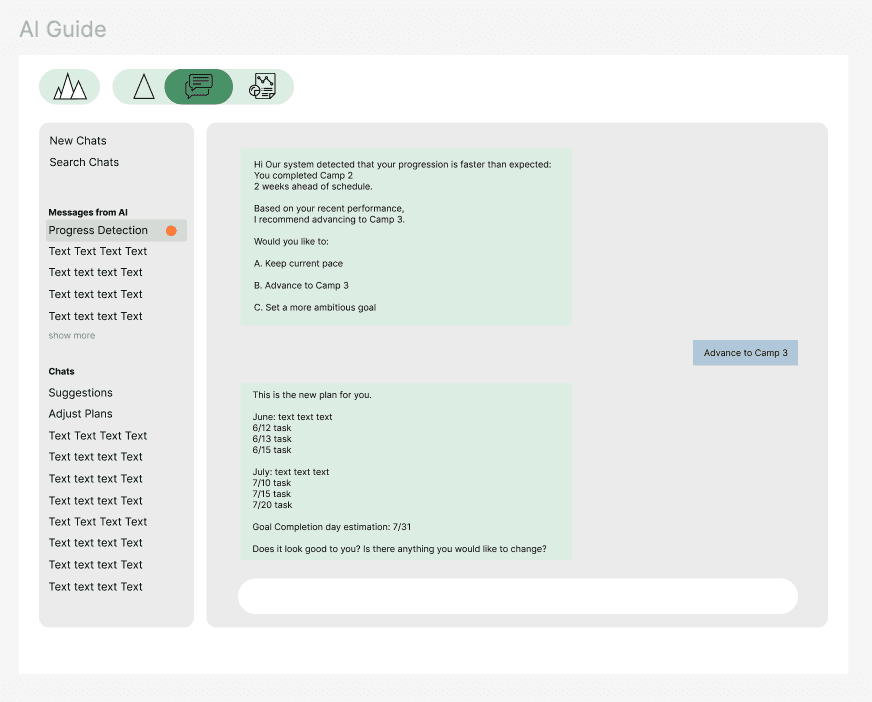
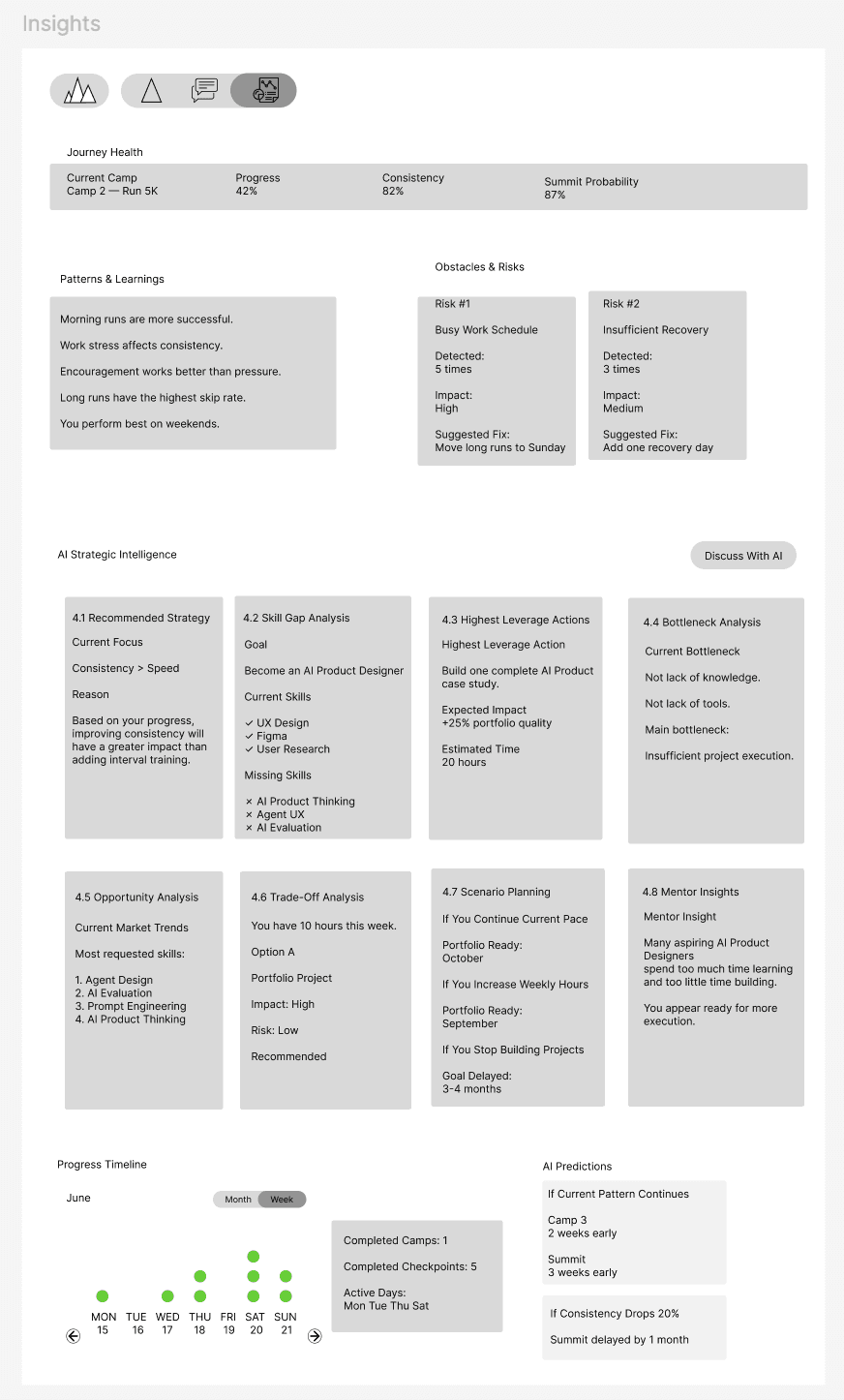
At this stage, the core product model worked conceptually. The harder Human–AI interaction problems only became visible once I implemented and started using the flow.
05 - Refining the Human–AI Planning Experience
Once I implemented the first flow and began self-testing it across different goals, a second layer of problems became visible.
The challenge was no longer only what Goal Mountain should do, but how the AI should behave while doing it: how much it should ask, how much control it should have over a plan, and how adaptation could happen without becoming intrusive or unpredictable.
Make the route useful without over-interviewing the user
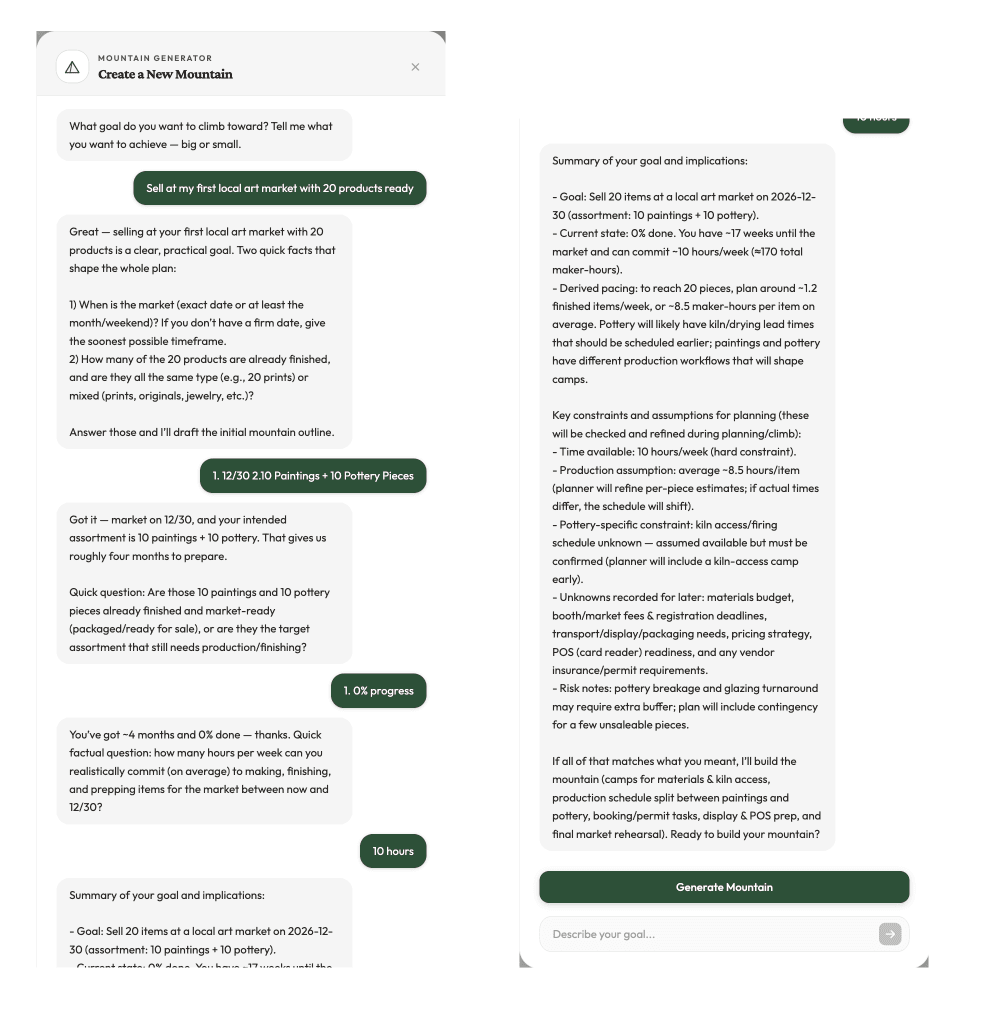
Early versions of the Mountain intake tried to gather enough context upfront to make the first route highly personalized. In self-testing, however, the conversation could start to feel like a form hidden inside chat bubbles, with the AI asking about information that was useful but not always necessary before generation.
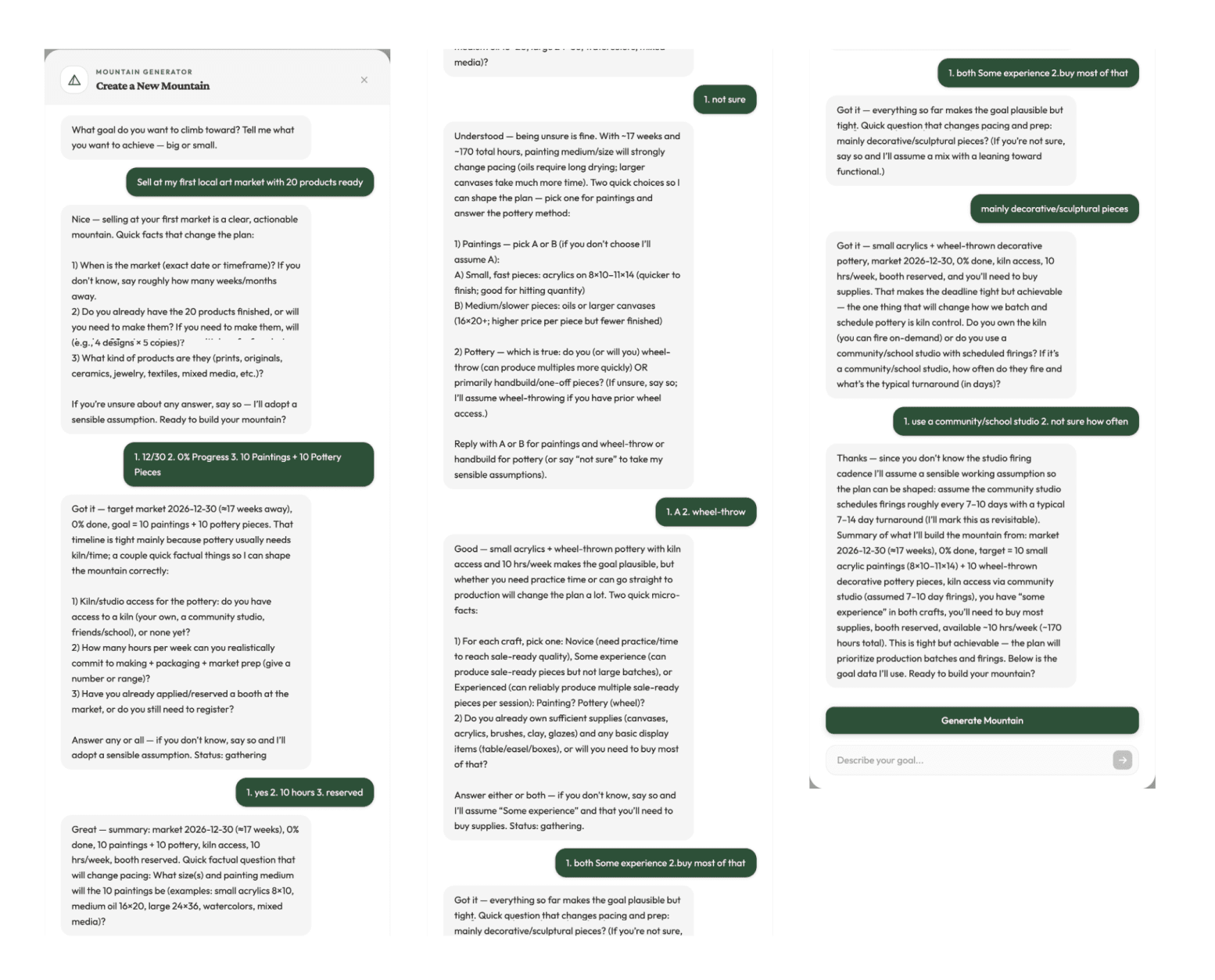
I shifted the intake from collecting maximum context to identifying minimum viable understanding. Before asking another question, the system considers whether the answer would materially change the milestones, sequencing, pacing, feasibility, or a critical constraint.
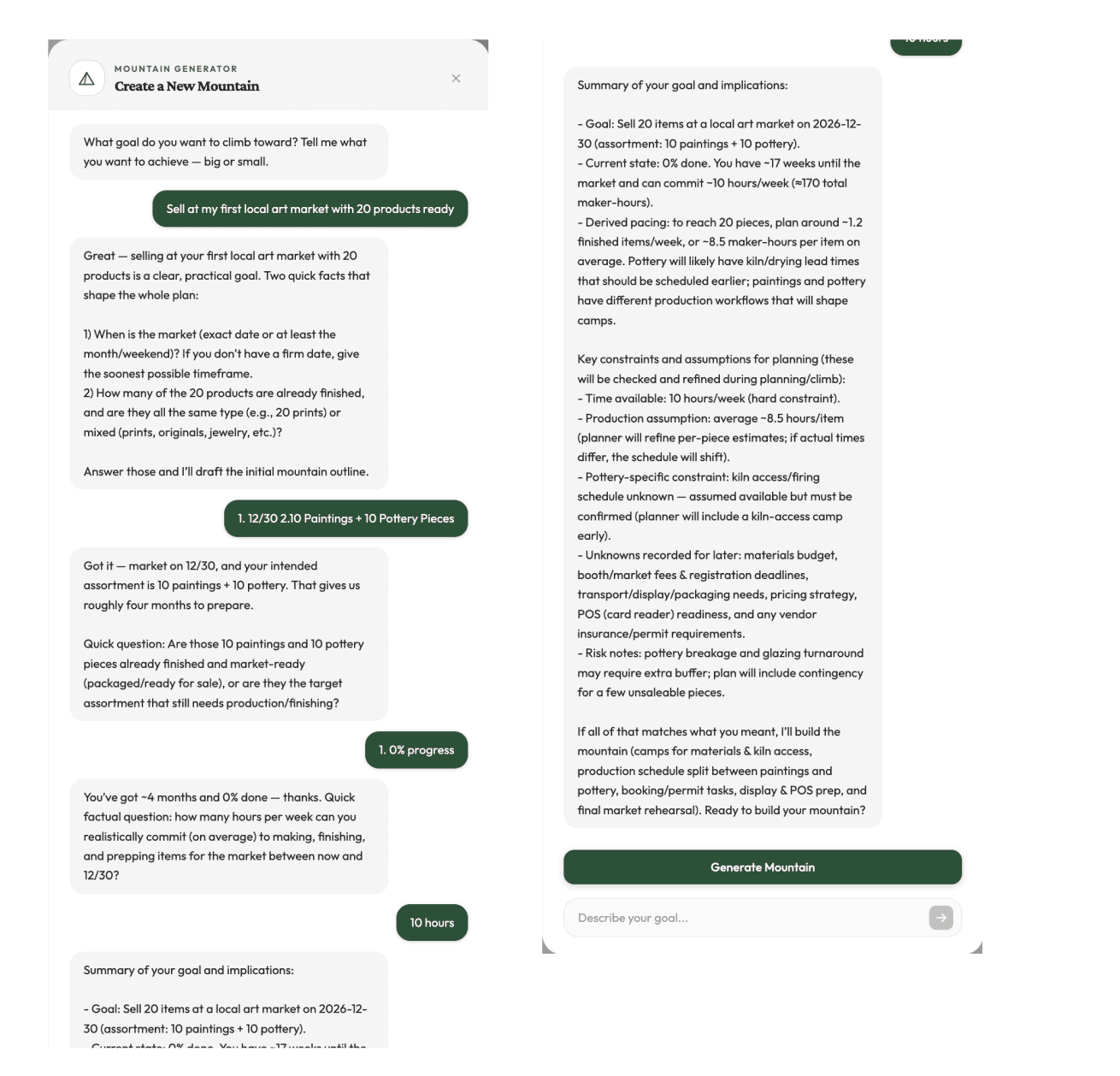
The current flow prioritizes roughly 3–4 high-value follow-up turns. Users provide facts about their situation; domain judgments such as the appropriate milestones or progression remain the responsibility of the AI. When users are unsure, the system can make a revisitable recommendation rather than repeatedly asking them to decide.
Design principle: Minimum viable understanding, not maximum information.
Treat AI-generated plans as proposals users can steer
The Weekly Plan introduced a different problem. Initially, when the AI-generated plan felt wrong, the most visible correction path was Discuss with AI—even for simple changes such as moving or shortening one task.
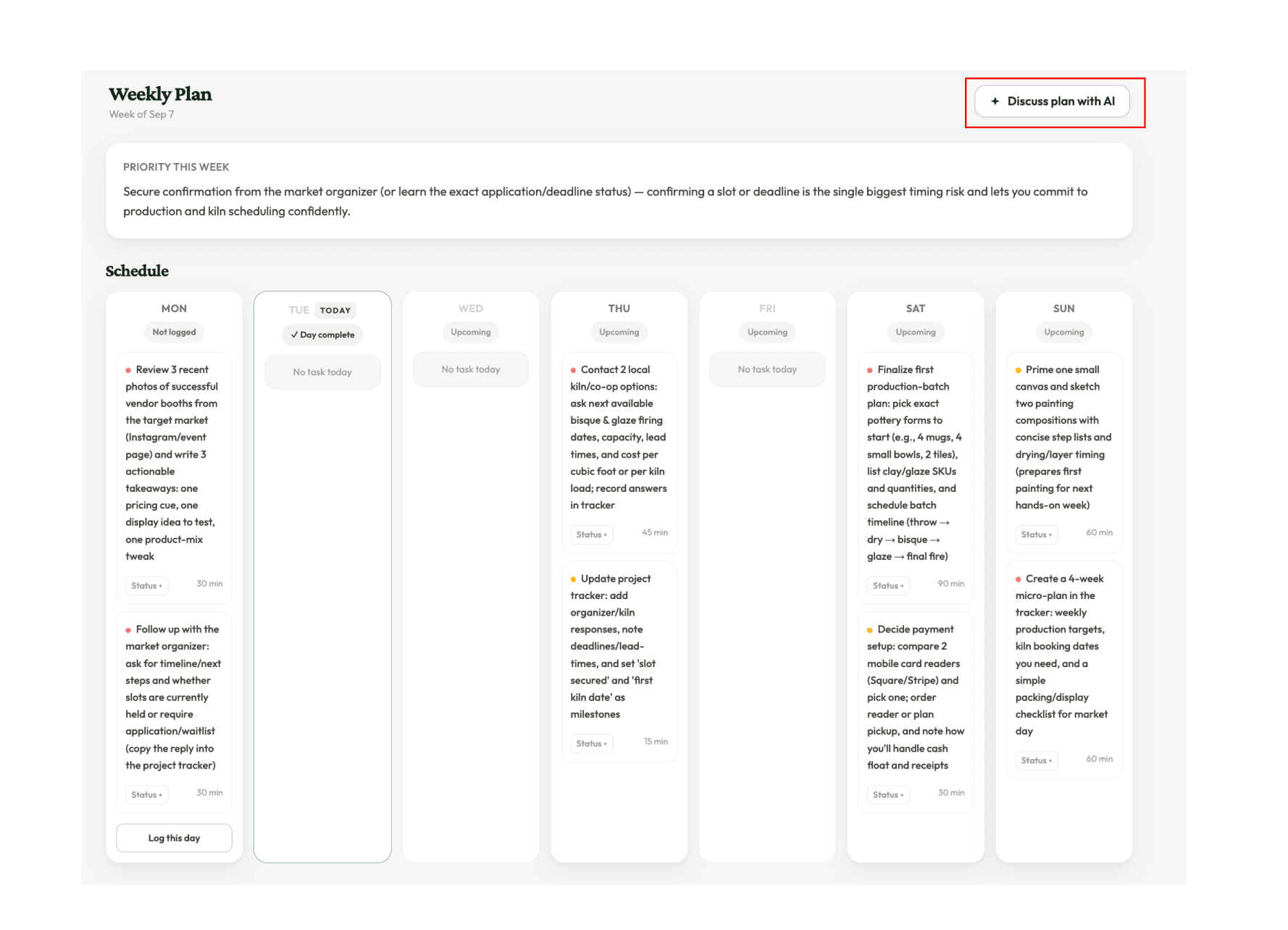
I realized that conversation should be an escalation path, not the default interface for every AI-assisted action.
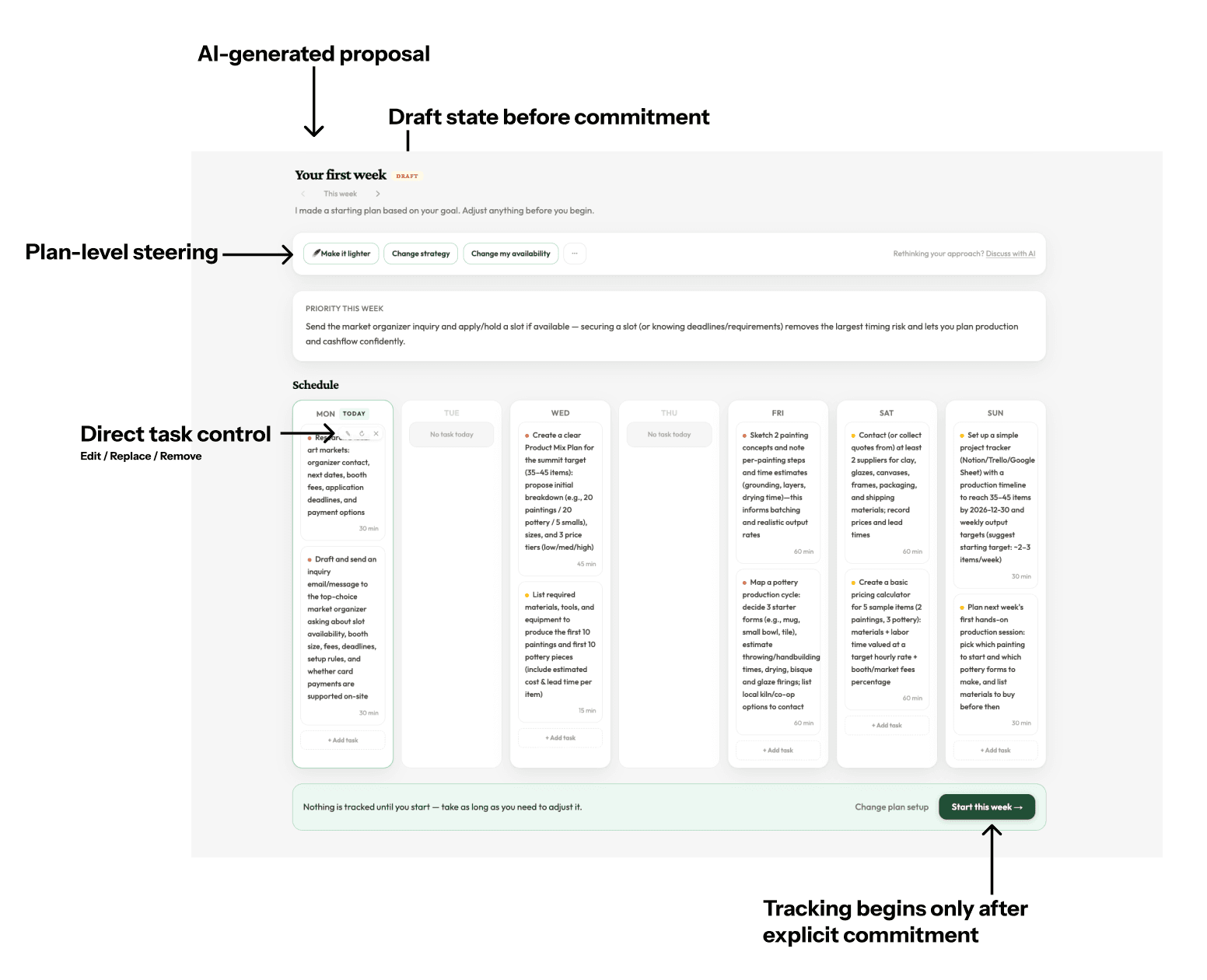
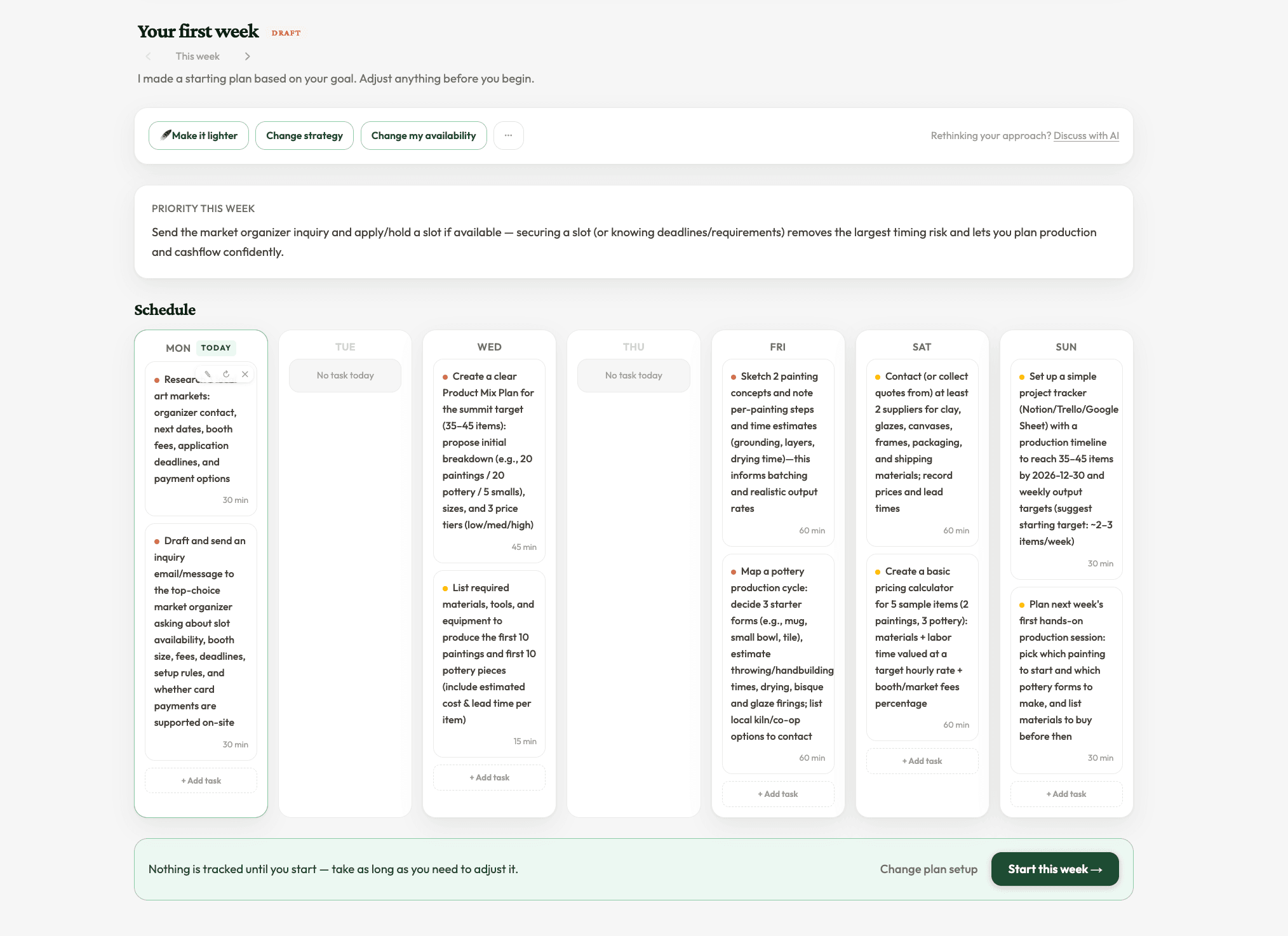
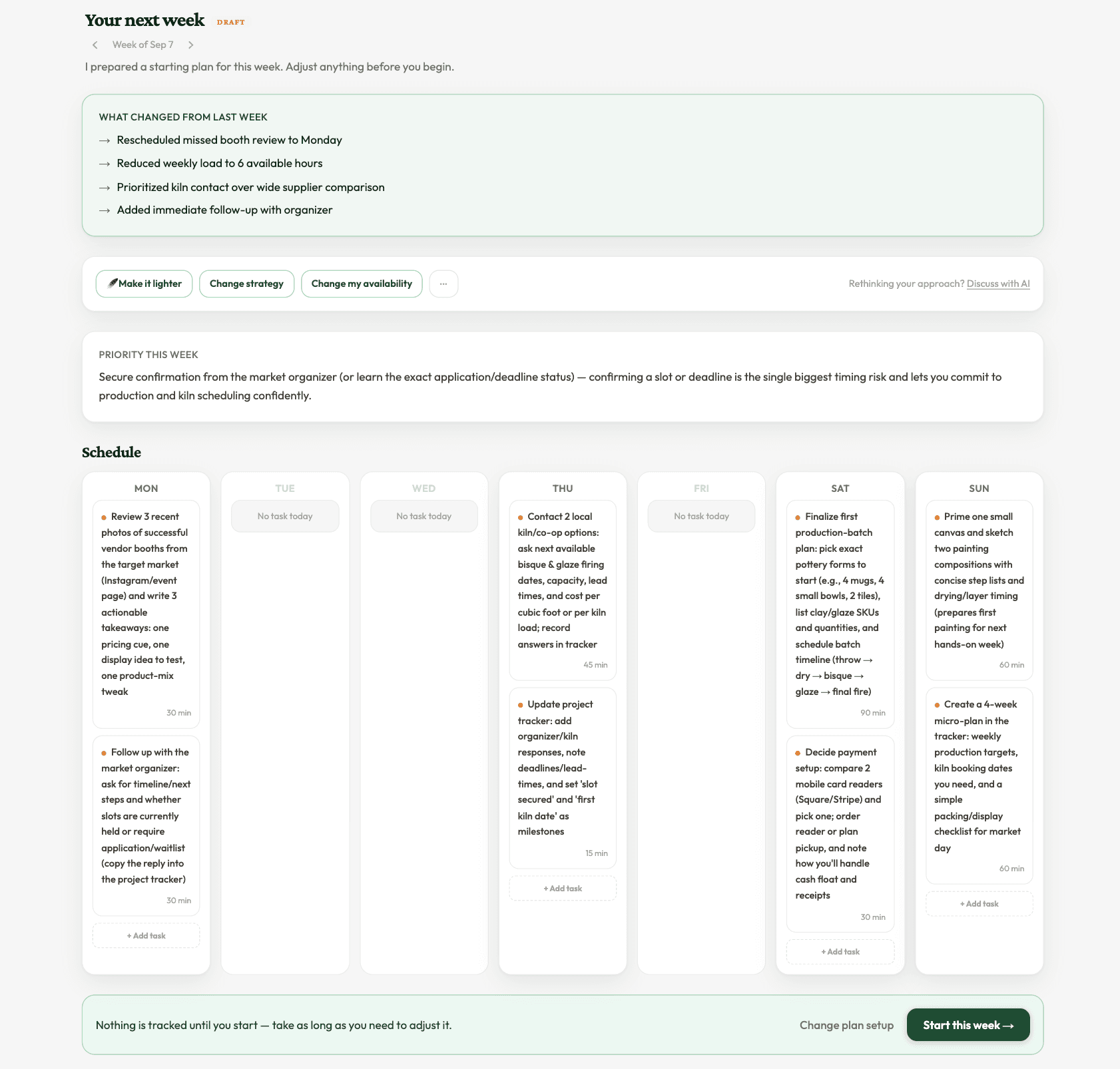
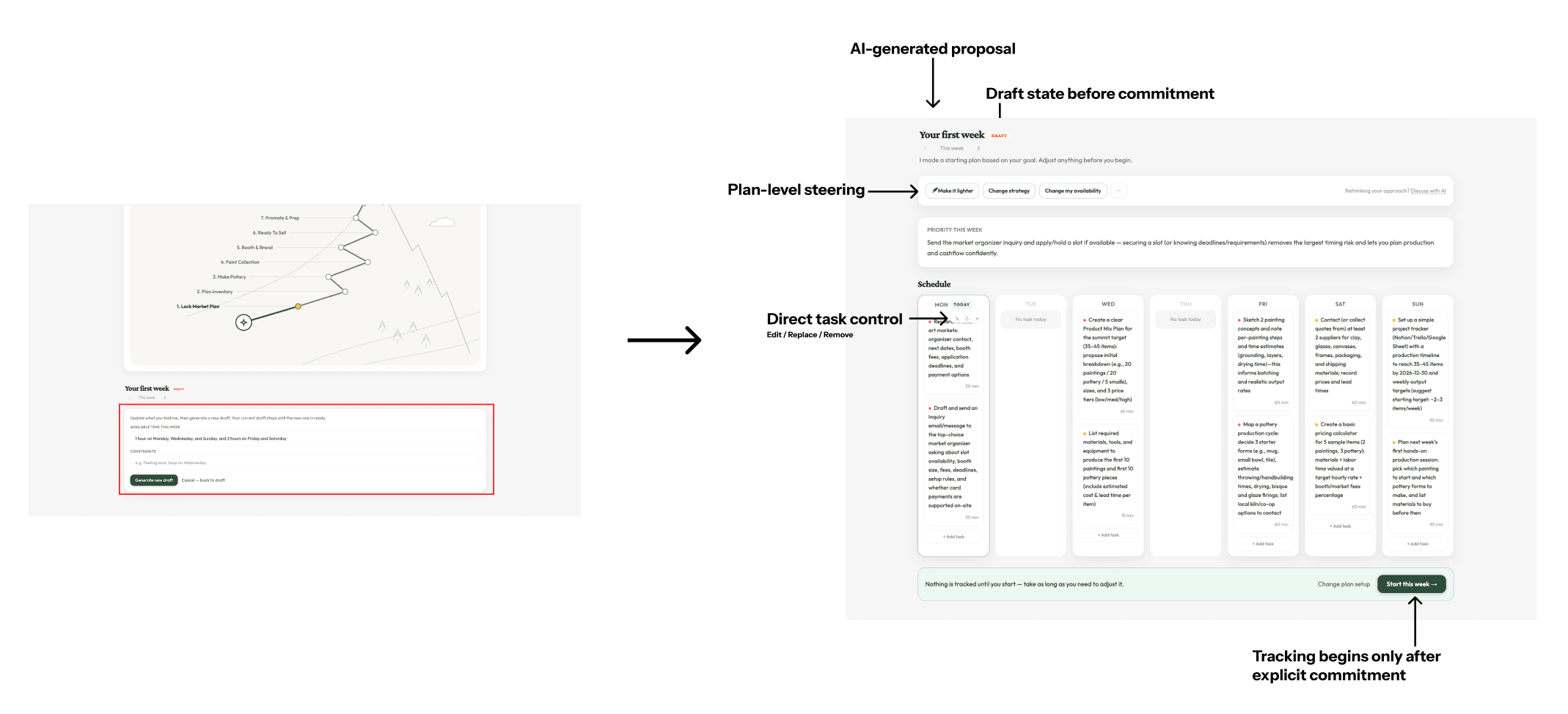
Every weekly plan now begins as a Draft. Users can review and modify it before pressing Start this week; only then does it become Active and begin producing tracking data and behavioral evidence.
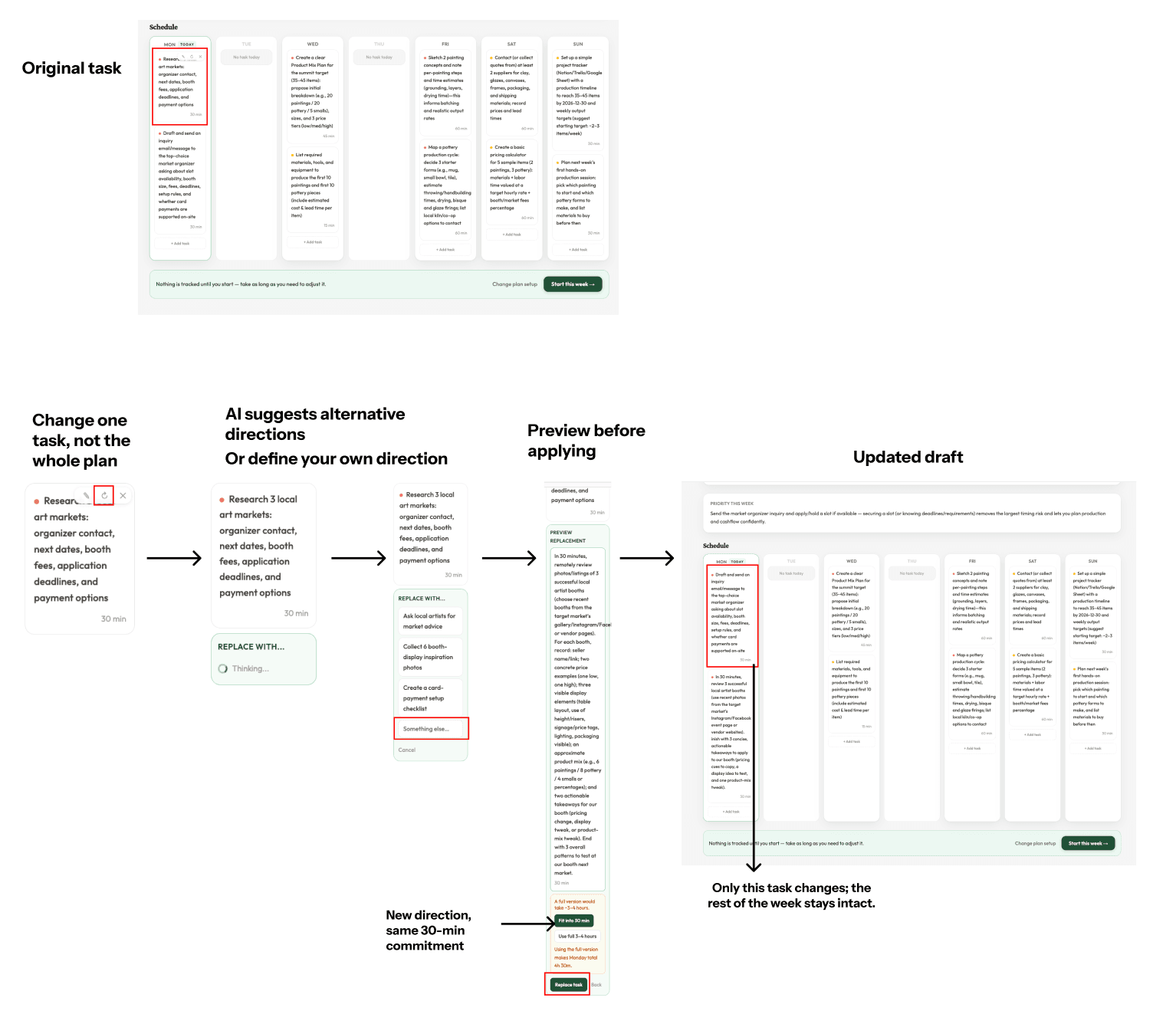
I also separated corrections by intent:
- Edit — I know exactly what should change.
- Replace — I want an alternative.
- Remove — This task is unnecessary.
- Change strategy / Change availability — The week needs broader adjustment.
- Discuss with AI — I have complex context that requires reasoning.
AI-assisted edits also preserve boundaries. For example, replacing a 20-minute task should not silently turn it into a two-hour task unless the user explicitly accepts that change.
AI proposes → human steers → human commits.
Let guidance learn progressively—and show what changed
Adaptation creates another tension: the plan should respond to reality, but an AI that continuously rewrites user commitments can quickly become unpredictable.
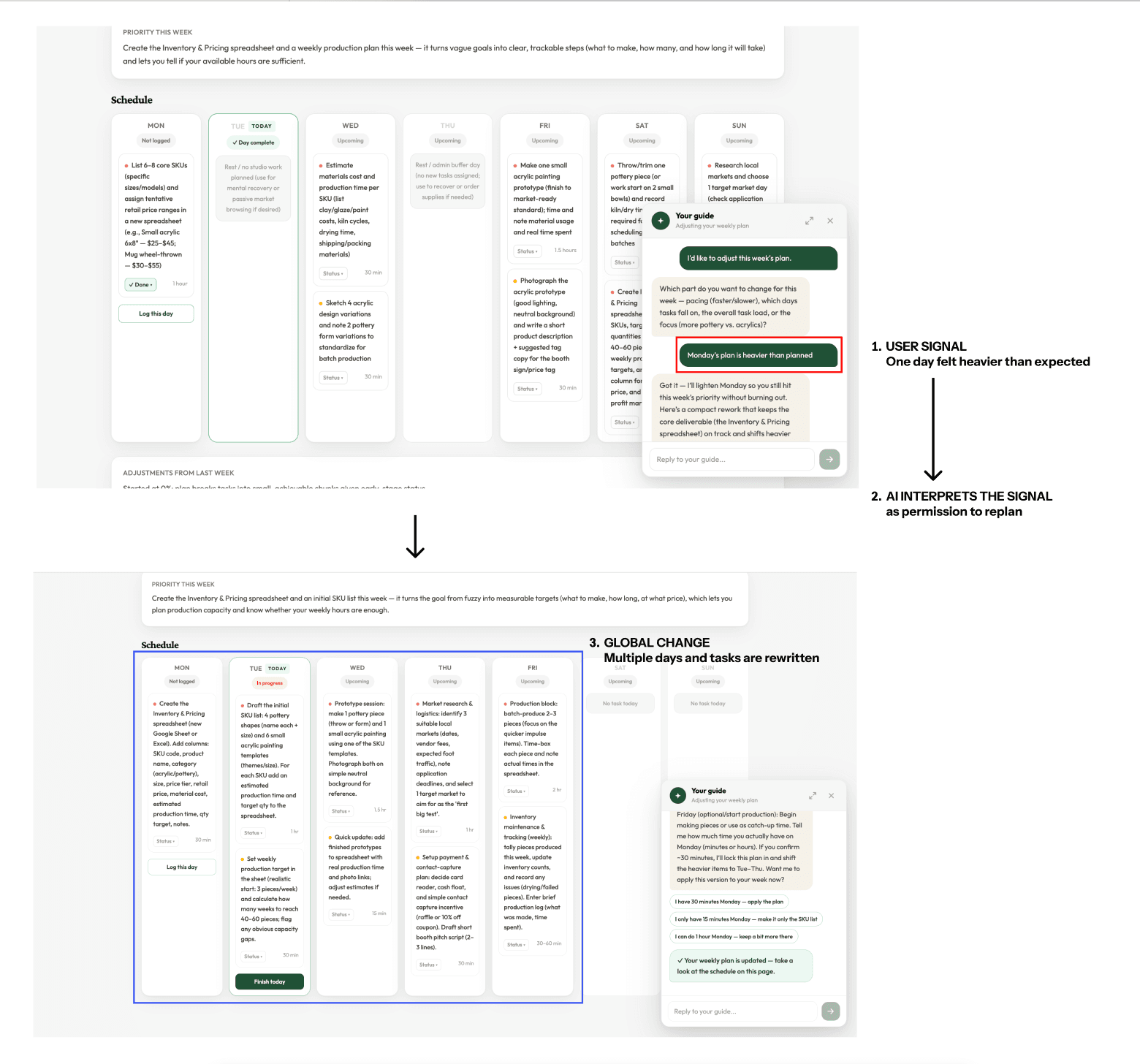
Meaningful AI-generated plan changes therefore become Proposed Revisions rather than silently replacing the current schedule. Users can review what changed before choosing to apply it.
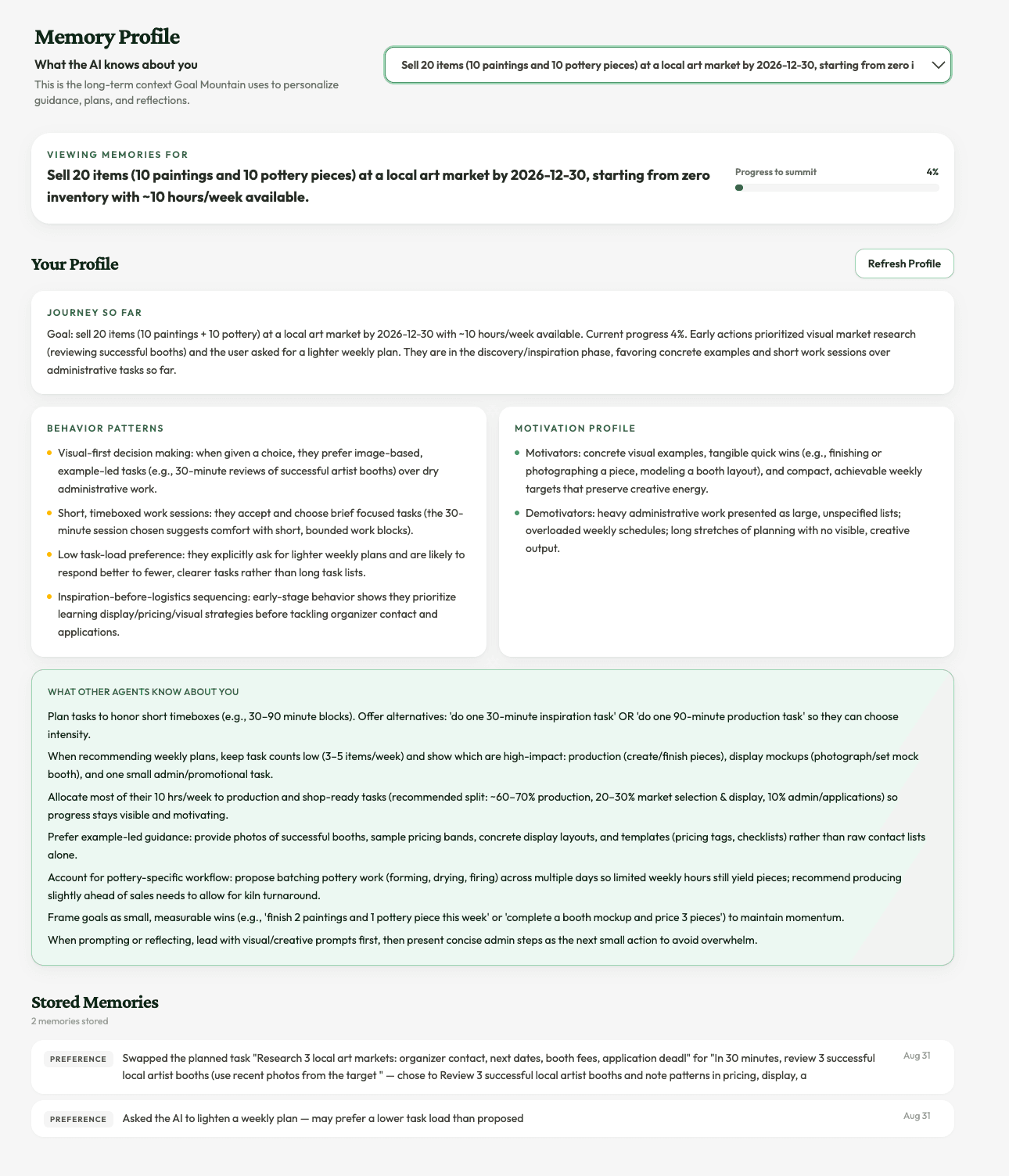
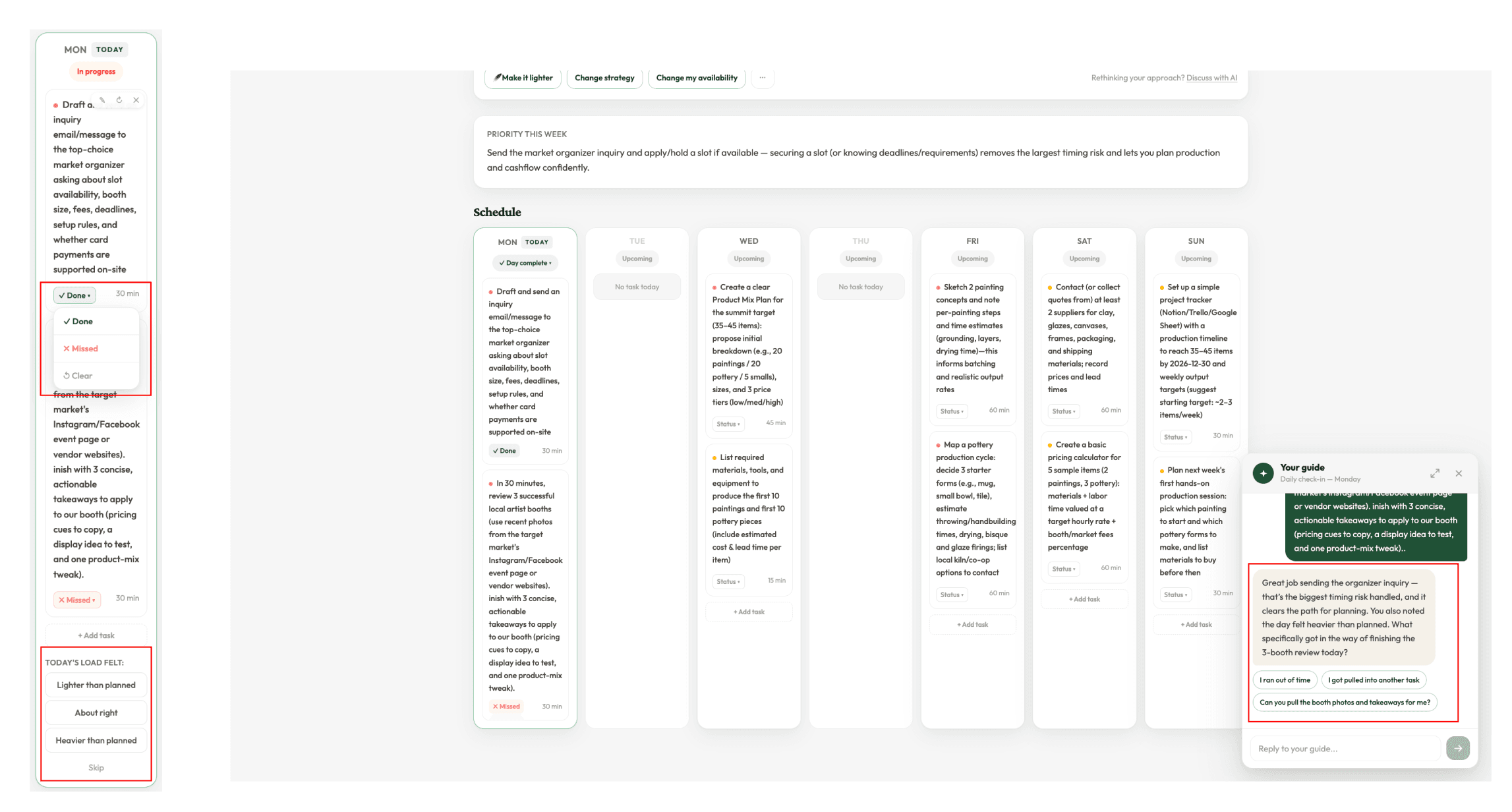
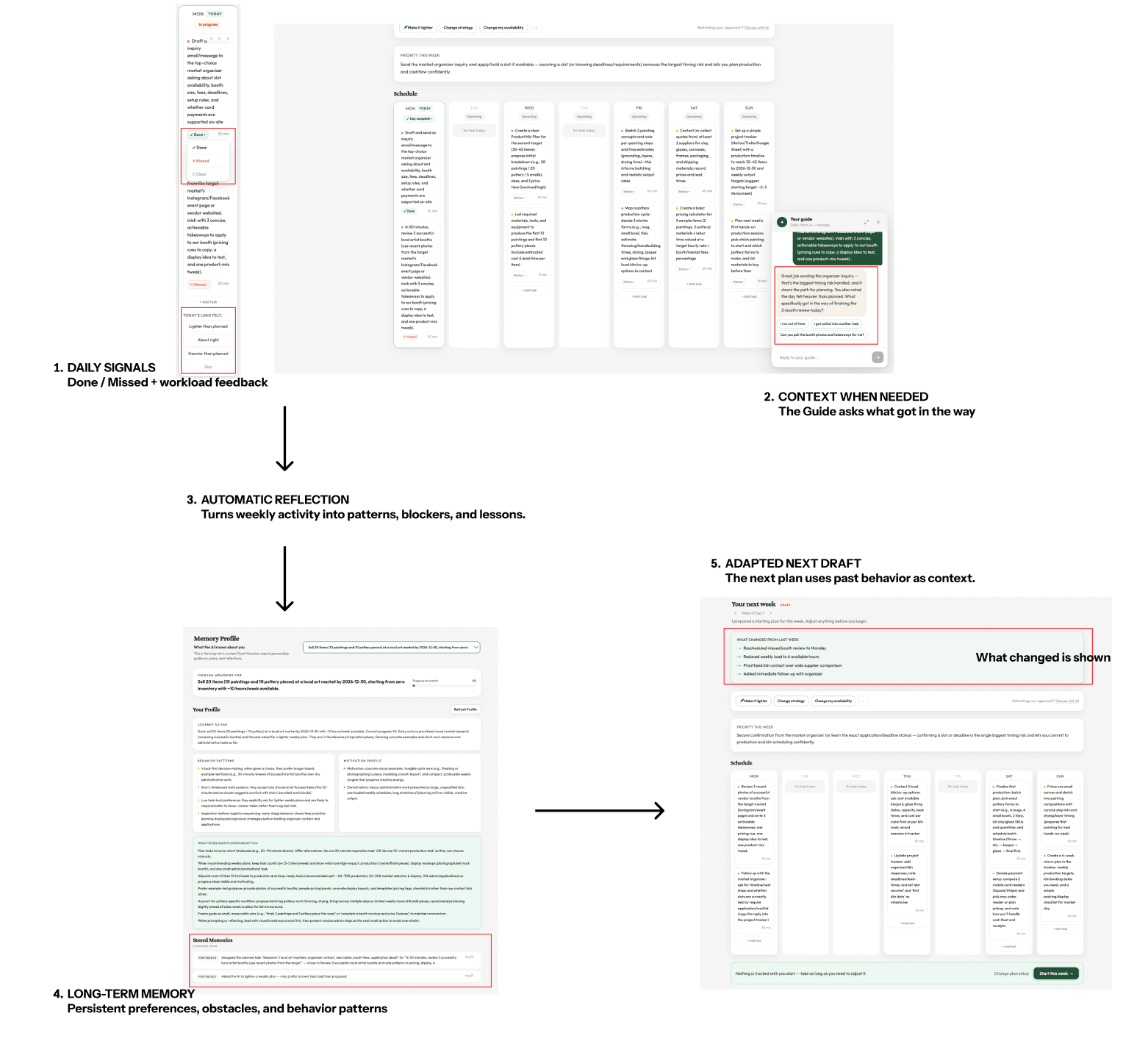
I applied the same low-friction principle to behavioral learning. Instead of requiring per-task time tracking or a manual weekly reflection, Goal Mountain captures lightweight signals—Done / Missed and whether the day’s workload felt lighter, appropriate, or heavier. Earlier iterations deliberately removed more burdensome logging because they risked turning the product into a timesheet.
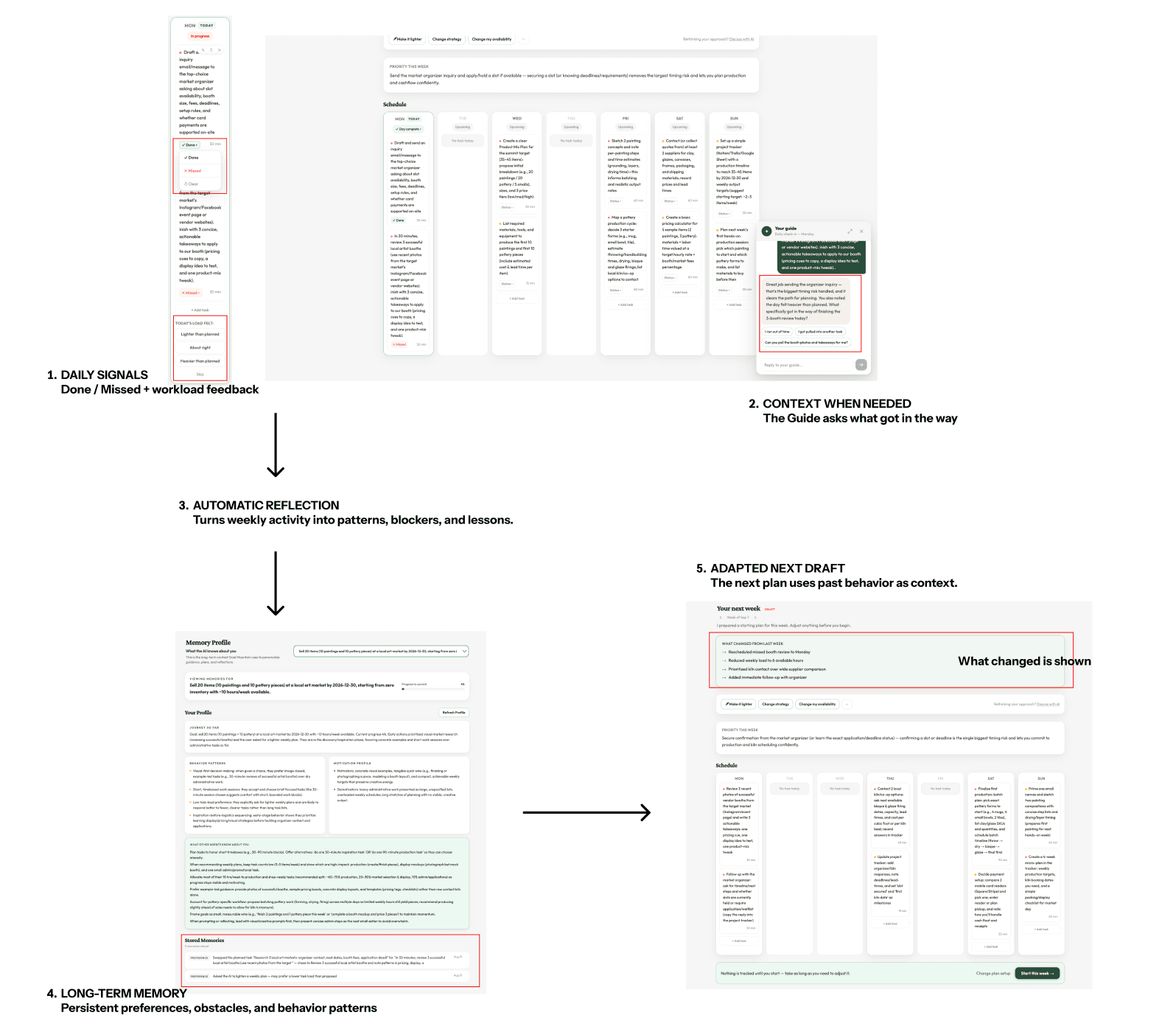
These signals feed automatic reflection and long-term memory, which then inform future plans. The next Draft surfaces What changed from last week, making adaptation visible rather than leaving users to guess why the AI changed its recommendation.
Plan → Act → Check in → Reflect → Remember → Adapt
Design principle: Personalization should become richer through use, while meaningful AI changes remain visible and controllable.
06 - The Current MVP
The Current MVP
The MVP connects long-term direction, weekly action, lightweight progress signals, and long-term AI memory into one adaptive loop.
Understand → Plan → Act → Learn → Adapt
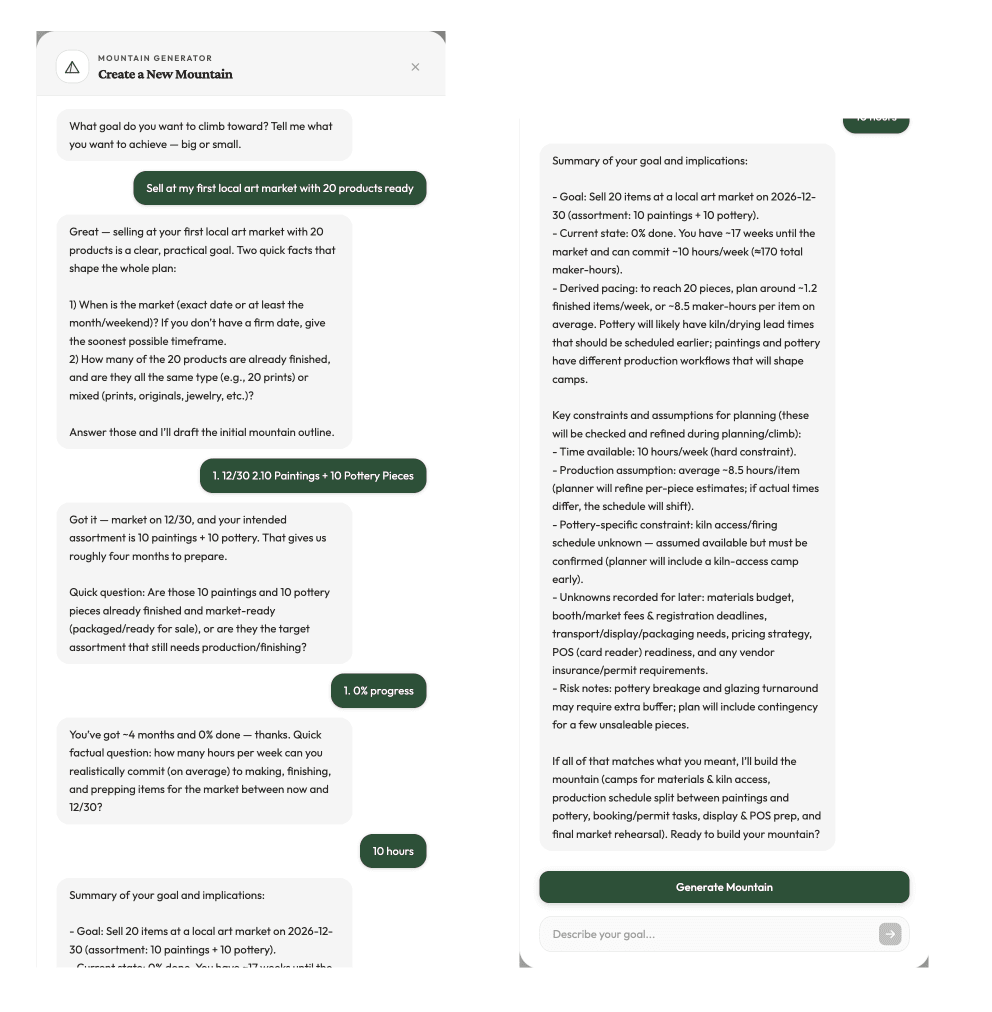
1. Build enough context to shape the route
2. Turn the goal into a route and actionable week

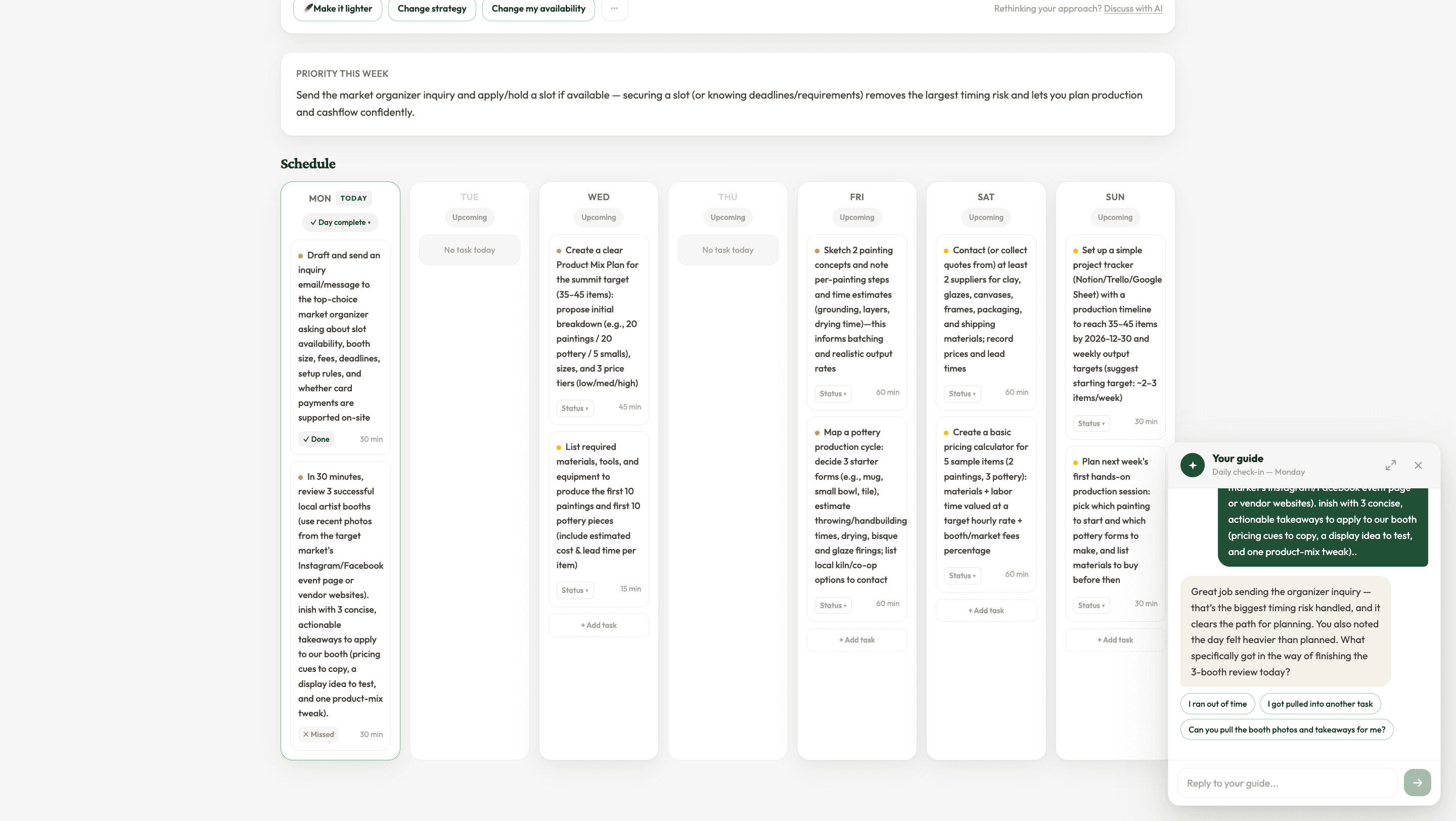
3. Take action, check in, and steer
FOR THE USER
FOR THE SYSTEM
4. Turn progress into insights and memory
5. Use that context to shape what comes next



Turn an ambition into a route
From vague ambition to a grounded route
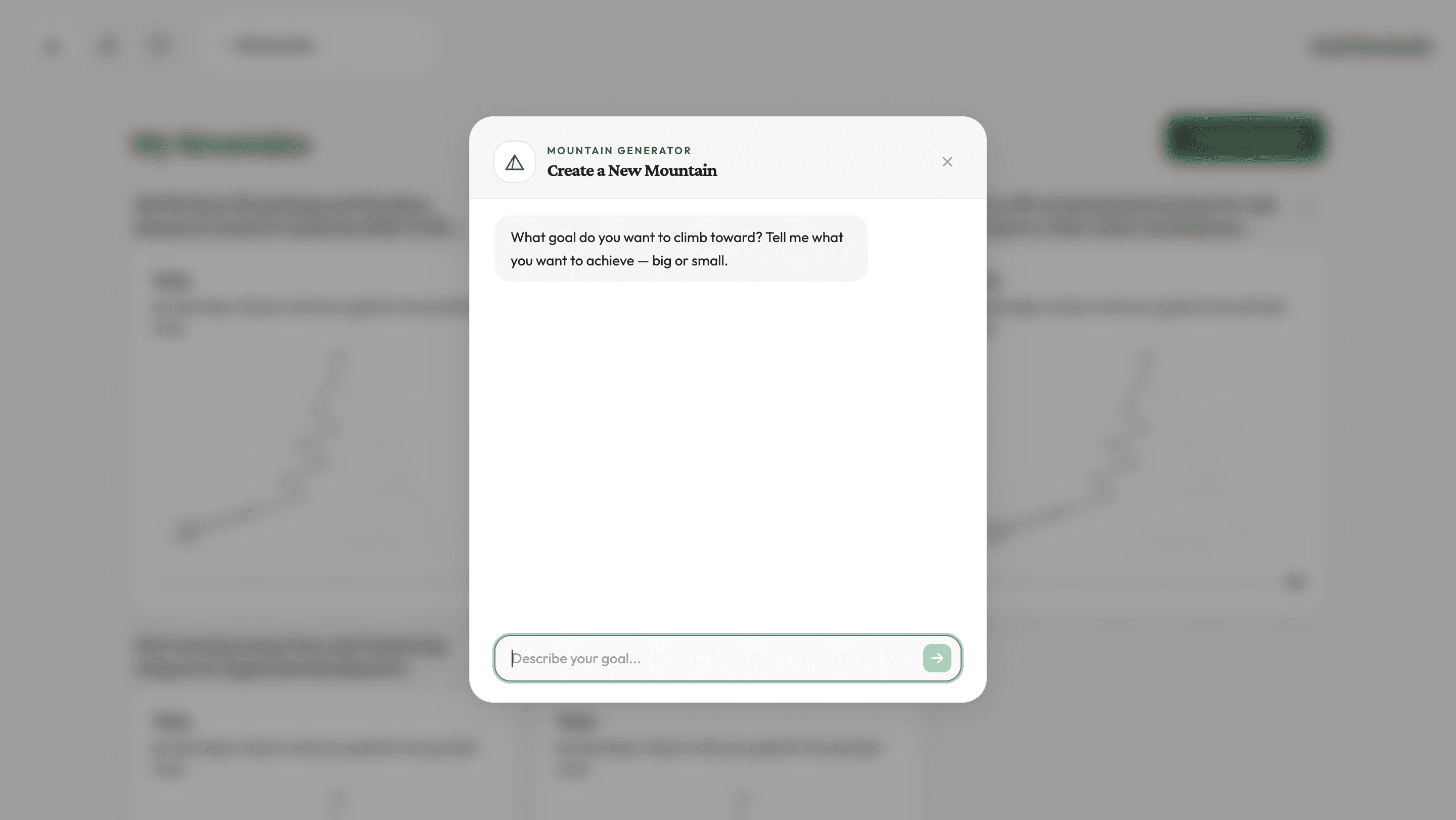
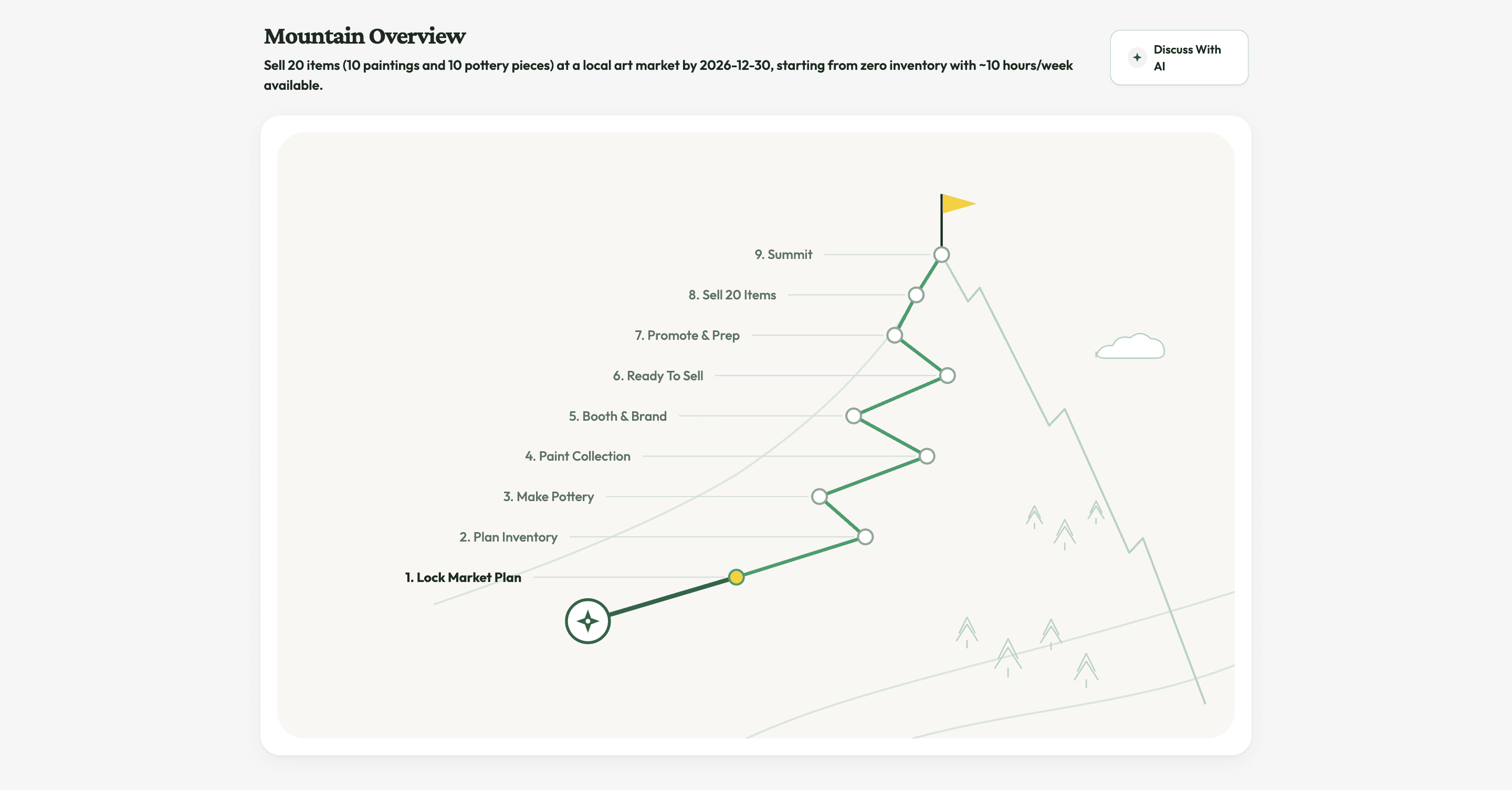
The user starts with a goal, not a form. After collecting only the context that materially affects the route, Goal Mountain researches the domain and generates a personalized sequence of milestones leading to a measurable summit.
Conversation
Conversational intake
Captures goal, starting point, timing, capacity, and critical constraints.

Grounding
Research-grounded generation
Uses external domain knowledge to shape realistic stages.
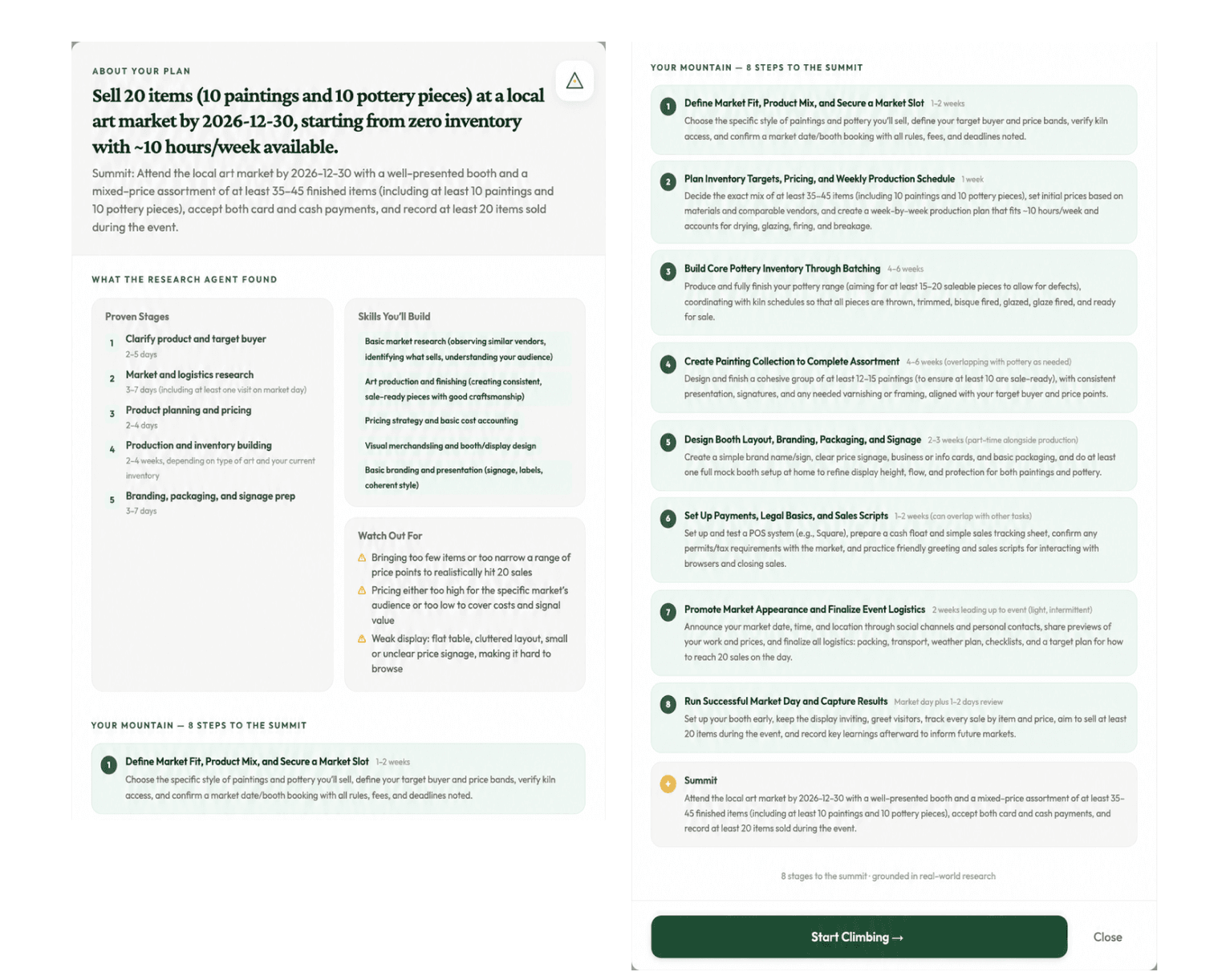
Route
Mountain journey
Makes the long-term route visible before the user starts planning individual tasks.
Turn the current milestone into a plan the user controls
AI proposes. The user remains in control.
Weekly plans begin as drafts rather than commitments. Users can directly manipulate individual tasks, steer broader strategy, or bring complex context into the AI Guide before activating the week.
Weekly Plan Draft state
AI proposal → Replace → Preview → Updated draft
Learn from progress without adding tracking burden
Lightweight feedback, only when it is useful
Once a plan is active, users provide lightweight signals through Done / Missed and workload feedback. A clean day closes without conversation; when tasks are missed or the load feels heavier, the Guide can step in with a contextual follow-up.
Show the learning loop
The system gets more useful through use
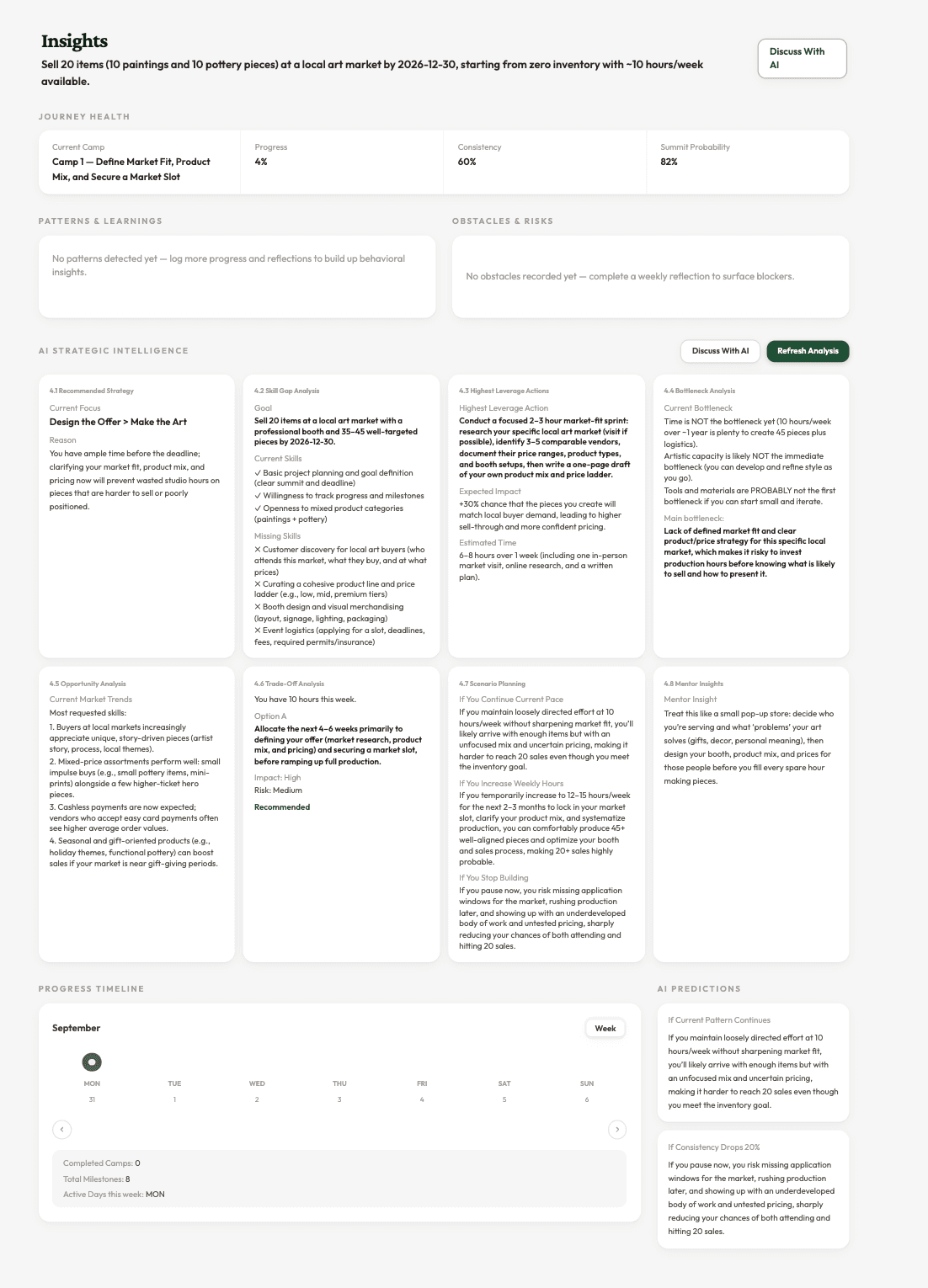
Progress is not only recorded—it becomes context. Automatic reflection extracts patterns from the user’s actual week, long-term memory preserves useful signals, and future plans use that history to adapt. The next draft then makes those changes visible instead of silently rewriting the user’s schedule.
One guide, grounded in the user’s journey
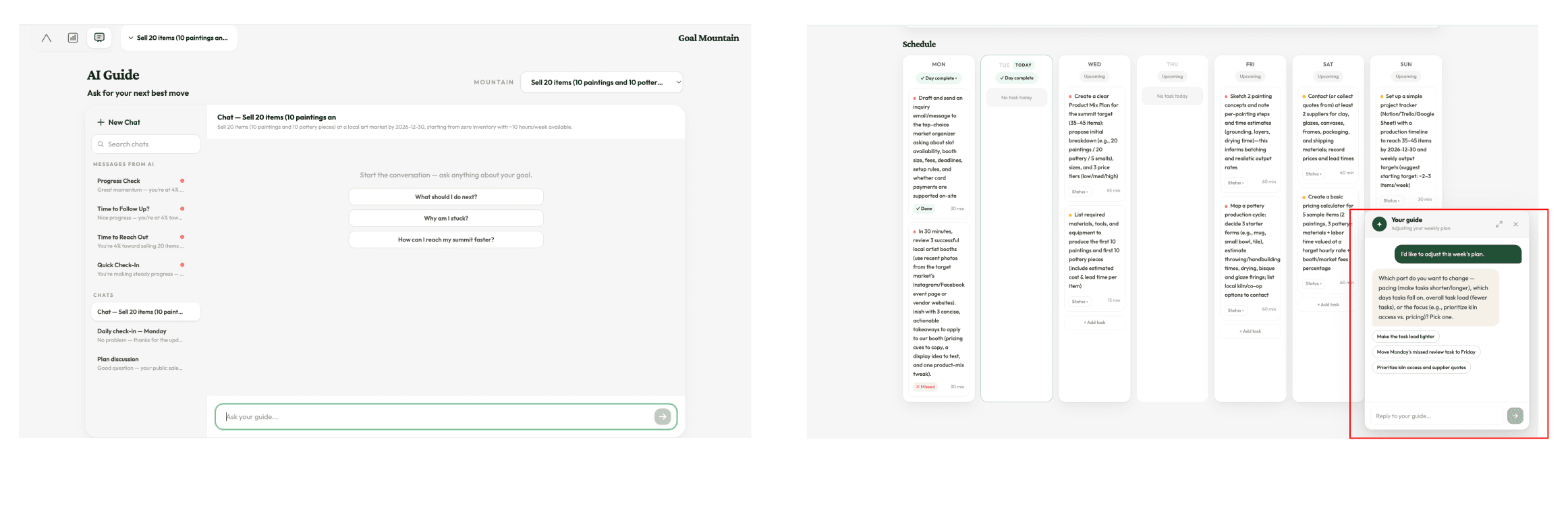
Contextual AI Guide
The same Guide can reason within one mountain or across multiple goals, using the user’s real plan, progress, reflection, and memories as context.
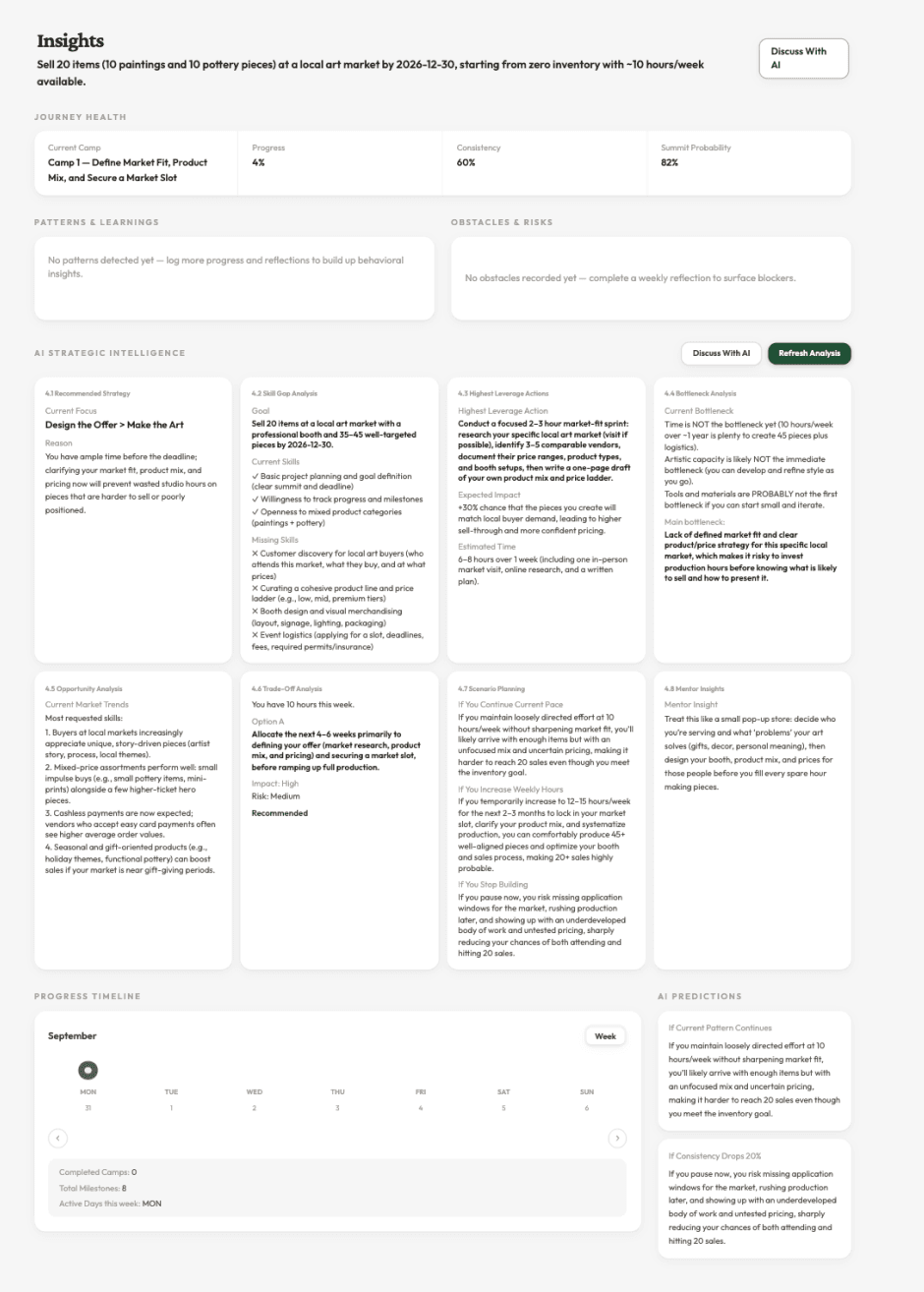
Strategic Intelligence
Insights turn accumulated journey data into patterns, bottlenecks, risks, trade-offs, and higher-level strategic guidance.